Canon RF 50mm f1.8 vs RF 50mm f1.2 – Review and comparison
We’re putting the Canon RF f/1.2 50mm lens against the Canon RF f/1.8 50mm lens, otherwise known as “The Nifty Fifty” to see just how much more quality you get for £2300? The RF f/1.2 currently retails at around £2500, a whopping £2300 ($2,099) more than the ever-reliable RF f/1.8 500mm lens, which you can pick up for around £200 ($199.99).
NB: Below there are some affiliate links and TSOP will receive a small percentage of some purchases made.
Physical differences between the Canon RF 50mm f/1.2 and ‘The Nifty Fifty’
Firstly, we’ll start with obvious and look at the physical differences between the two lenses.
The f/1.2 is huge in comparison to the f/1.8. It also feels a lot sturdier and is heavier than its cheaper opponent. The f/1.8 lens is very lightweight – it only weighs 160g, compared to the 950g of the f/1.2 and measures at 40.5mm (as opposed to the 108mm of the f/1.2) and is geared towards photographers of all levels whereas the Rf 50mm f/1.2 is geared towards professional use.
The focusing on the f/1.2 is also a lot quicker and quieter than the f/1.8 and has better weatherproofing. And you get just over an extra stop of light with the f/1.2 lens.
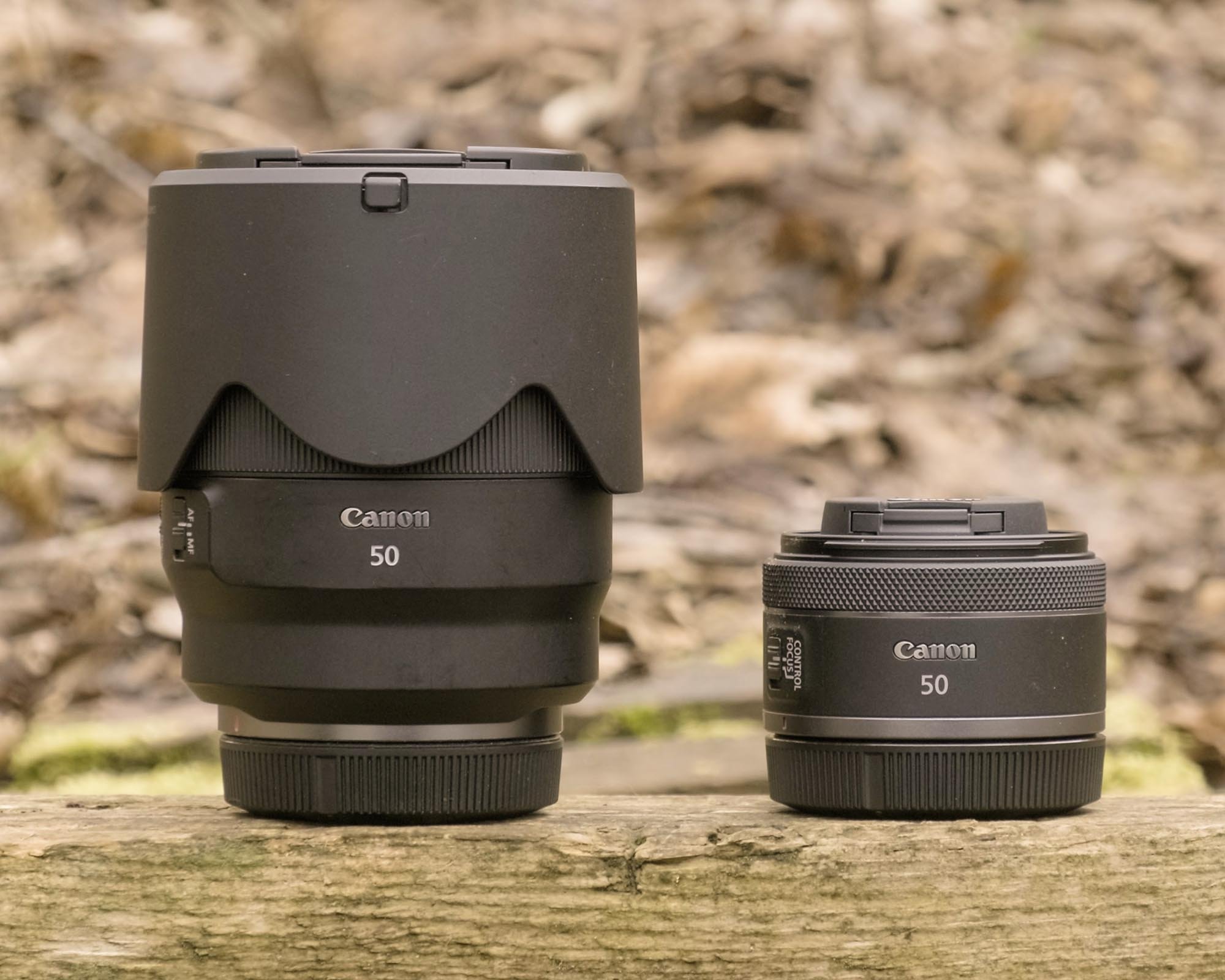
The RF 50mm f/1.2 is much bigger in comparison to the RF 50mm f/1.8 aka the ‘Nifty Fifty’.
The Canon Lens Test
We’re going to check each lens as scientifically as possible – we’re going to keep the same subject, settings and conditions and compare the depth of field, sharpness, colour rendition and bokeh of each lens.
We’re going to be comparing the results in images shot at f/11, f/5.6, f/2.8, f/1.8 and f/1.2
We’re shooting in the woodland in winter, and it’s overcast which gives us soft light to shoot in. Here’s the camera settings that we’re going to be using:
AV (aperture priority)
Shutter Speed (this will change based on the F/stop that we’ll be using)
ISO 100
Cloudy white balance – To best match the colour temperature of the light.
2 Second Timer – we’re using a 2 second timer and a tripod to reduce the risk of camera shake.
Camera Body is the Canon R5 – this is a full-frame mirrorless camera. Find out more about the Canon mirrorless range here.